
The Joy of Childhood Codes
Most of us have tried to create a "secret code" at some point. Maybe you and your best friend passed notes in class with every letter shifted by one. Maybe you invented a symbol for each letter. The impulse to encrypt is deeply human. We crave privacy, mystery, and the thrill of knowing something others don't.
Shift ciphers (also called substitution ciphers) are the simplest form of encryption. They are not secure against modern attacks, but they are fun, educational, and surprisingly useful for casual obfuscation.
The Shift Cipher Family
A shift cipher replaces each letter with another letter a fixed distance away in the alphabet. The Caesar Cipher is the most famous example (shift of 3), but you can use any shift from 1 to 25.
Examples:
Shift 1 (A→B): "HELLO" → "IFMMP"
Shift 5 (A→F): "HELLO" → "MJQQT"
Shift 13 (ROT13): "HELLO" → "URYYB"
ROT13: The Internet's Spoiler Shield
ROT13 is special because a shift of 13 is its own inverse. If you encrypt text with ROT13 and then encrypt it again, you get back the original text. This makes it trivially easy to encode and decode.
ROT13 is not secure. Anyone can decode it instantly. But it serves a social function: it hides spoilers, puzzle answers, or mildly offensive jokes in a way that requires intentional action to reveal. It is like a "click to reveal" button, but in pure text.
You see it on forums like Reddit, Stack Exchange, and old Usenet groups. "The killer is [rot13: gur ohgyre]." If you want to know, you decode it. If you don't, you scroll past.
Building Your Own Shift Cipher Tool
Creating a shift cipher encoder is a great first project for learning programming. Here is the logic:
- Take the user's input text.
- For each character, check if it is a letter.
- If it is a letter, shift it by the key amount.
- If it is a space, punctuation, or number, leave it unchanged.
- Handle wrapping (Z + 1 = A).
Using an online tool saves time. You paste your message, select a shift value, and instantly get the encrypted result. It is perfect for sending "coded" messages in group chats or creating puzzle hunts for friends.
Practical Uses Today
Geocaching Puzzles
Geocaching (real-world treasure hunting with GPS) often includes encrypted coordinates or clues. Simple shift ciphers are common because they are solvable with pen and paper.
Escape Rooms
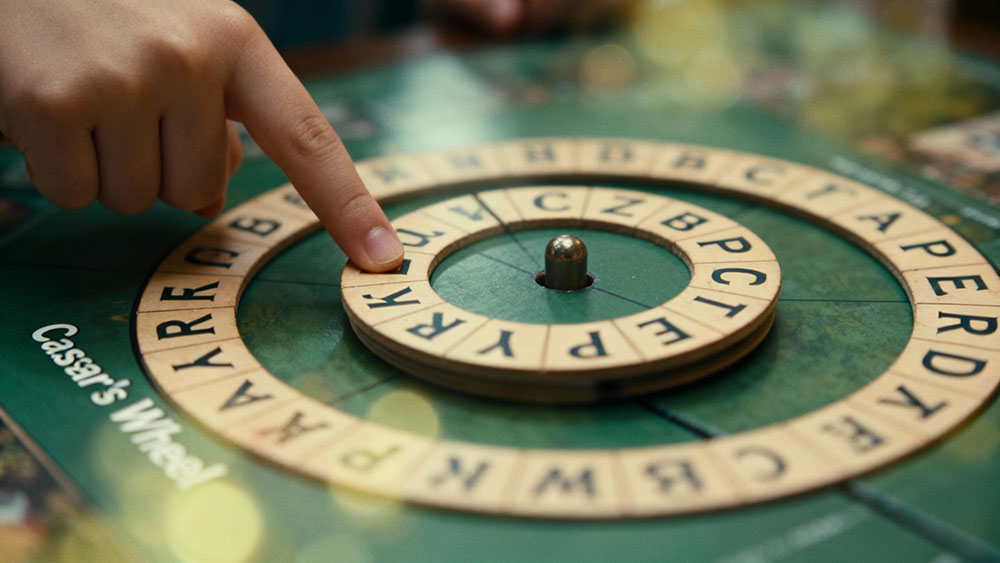
Many escape room designers use shift ciphers for clues. They provide an "alphabet wheel" (two rings of letters where you can rotate one ring to decode messages).
Personal Journaling
Some people journal in ROT13 or a custom shift as a mild privacy layer. It won't stop a determined reader, but it prevents casual snooping.
The Weakness: Brute Force is Trivial
There are only 25 possible shifts. An attacker can try all of them in seconds. Tools exist that automatically test all shifts and display the one that looks most like English. This is called a "brute force attack."
For this reason, shift ciphers should never be used for anything sensitive. They are toys. Fun, educational toys, but not security tools.
Upgrading: The Substitution Cipher
If you want something slightly more secure, you can use a full substitution cipher where each letter is mapped to a random different letter (not just a shifted one). For example:
A→Q, B→W, C→E, D→R, etc.
This increases the number of possible keys to 26! (factorial), which is 403,291,461,126,605,635,584,000,000 combinations. However, it is still vulnerable to frequency analysis.
Conclusion
Shift ciphers are the gateway drug to cryptography. They teach the concept of keys, the process of encoding/decoding, and the fundamental idea that obfuscation is not the same as security. Build one. Play with one. But when you need real secrecy, reach for AES-256.