
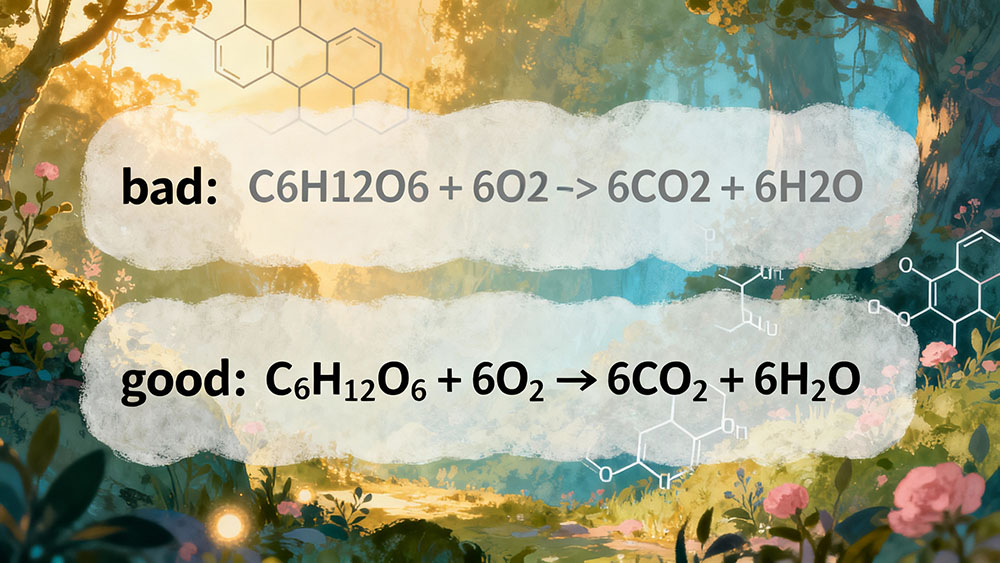
Chemistry in Plain Text
If you are a student, teacher, or science enthusiast, communicating chemistry online is frustrating. You want to write the formula for glucose. In a proper editor, you have subscript buttons. But on Twitter, Discord, or in a text message, you are usually stuck writing "C6H12O6".
It works, but it looks wrong. It looks like code, not chemistry. The "6", "12", and "6" should be small and sit below the line. We are trained to read them that way. When they are full-sized numbers, our brains take an extra millisecond to process the information.
The Subscript Solution
You don't need a complex typesetting system like LaTeX to fix this. You just need Unicode subscripts. These are specific characters that look exactly like tiny numbers placed below the baseline.
Instead of C6H12O6, you can write: C₆H₁₂O₆.
This is readable on almost every modern device. It creates a professional look in environments that supposedly "don't support formatting."
Common Formulas to Try
Once you have a subscript generator (or just a list of the characters to copy-paste), you can write complex reactions:
- Photosynthesis: 6CO₂ + 6H₂O → C₆H₁₂O₆ + 6O₂
- Combustion: CH₄ + 2O₂ → CO₂ + 2H₂O
- Sulphuric Acid: H₂SO₄
A Note on Arrows
The numbers are half the battle. The other half is the reaction arrow. A simple hyphen-greater-than sign (->) looks messy. Unicode offers better alternatives like the proper rightwards arrow (→) or the equilibrium arrow (⇌).
Combining subscripts for the stoichiometry and proper arrows for the direction turns a sloppy text message into a legible scientific statement.
Where This Fails
While subscripts for numbers (₀-₉) are standard, subscripts for letters are incomplete in Unicode. You can find many of them, but not all. So if you need to write a variable subscript like "X sub i" (Xᵢ), you are usually fine, but some specific letter combinations might be missing. For standard chemical formulas involving elements and numbers, however, it is nearly perfect.