
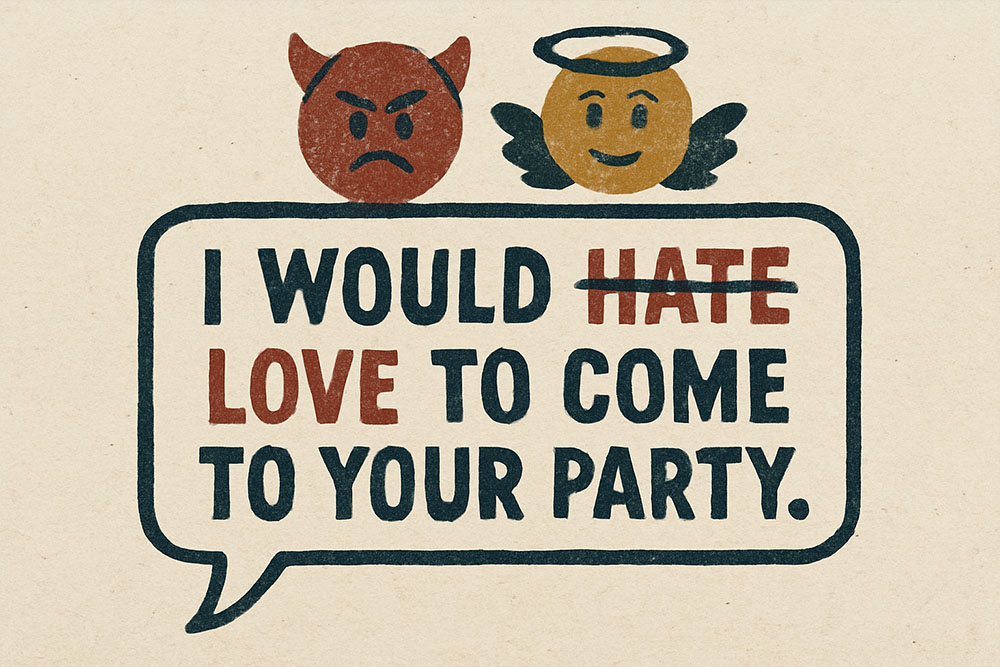
The Art of the Redacted Whisper
There is something inherently intriguing about a crossed-out word. It suggests a mistake, a censorship, or a second thought. In the analog world of pen and paper, a strikethrough meant "ignore this." But in the digital world of social media and memes, strikethrough text has evolved into a sophisticated linguistic tool known as "ironic erasure."
It allows you to say two things at once: the polite social lie, and the brutal crossed-out truth. For example: "I am so excited to ~~spend 5 hours on Zoom~~ attend the meeting." It creates a layer of subtext that plain text simply cannot convey. It turns a sentence into a story.
How Digital Strikethrough Works
You might wonder, "How do I type a line through a letter?" On a standard keyboard, you can't. There is no key for "crossed-out A."
Software like Microsoft Word uses "Rich Text" to draw a line over the letter. But you can't copy-paste that line into Instagram or a text message because those platforms only support plain text. If you paste it, the line disappears.
The solution lies in Unicode Combining Diacritics.
Unicode is the universal alphabet of computers. It contains not just letters, but "modifier" characters. One specific character is the `Combining Long Stroke Overlay` (U+0336). When you place this character immediately after a letter, the computer renders it on top of the previous letter.
Input: `T` + `[combining stroke]` + `e` + `[combining stroke]`...
Output: `T̶e̶s̶t̶`
A Strikethrough Generator automates this. It takes your sentence, inserts the combining stroke after every single character, and gives you a result that looks "crossed out" but is technically just a sequence of special characters. This allows it to work on Twitter, Facebook, TikTok, and almost anywhere else.
Creative Uses for Hidden Messages
1. The "Freudian Slip" Joke
This is the most common use. You write a socially acceptable statement, but strike through the part that reveals your true (lazy/greedy/angry) feelings.
"I’m starting my diet ~~tomorrow~~ next month."
It resonates because it feels honest. It mimics the way our internal monologue works.
2. Spoiler Protection (Low Tech)
Before Discord added proper spoiler tags (`||text||`), communities used strikethrough to indicate spoilers. While it doesn't fully hide the text, it signals to the reader "Do not read this if you haven't seen the movie." Visually, the line makes the text harder to scan, offering a tiny bit of protection against accidental glances.
3. To-Do Lists in Bios
Social media bios are static. You can't check off a box. But you can use strikethrough to show progress.
Goals 2026:
~~Run a marathon~~
~~Learn Spanish~~
Write a novel
This visualizes achievement perfectly in a plain-text environment.
4. Horror and Creepypasta
In horror writing, strikethrough can represent a corrupted file or a narrator losing their mind. Combined with "Zalgo" text (glitch text), it creates a disturbing visual effect.
"D̶o̶ ̶n̶o̶t̶ ̶l̶o̶o̶k̶ ̶b̶e̶h̶i̶n̶d̶ ̶y̶o̶u̶."
Limitations and Accessibility
A word of caution: Screen Readers (used by blind people) hate this.
When a screen reader encounters `T̶e̶s̶t̶`, it might try to pronounce the letter T, then the combining stroke (which has a weird name), then E, then the stroke. It sounds like gibberish: "T-stroke-E-stroke-S-stroke-T-stroke."
For this reason, never use strikethrough for critical information. Use it for jokes, for memes, or for aesthetic flair, but if the message is vital, write it plainly. If you use it on a website you control, use the proper HTML `` tag instead, which screen readers understand correctly. But for social media, the generator is your only option—just use it responsibly.