
The Fingerprints of Data
In the digital world, how do you prove that a file hasn't been tampered with? How do you store a password without actually storing the password? You use a Hash Function.
A hash function takes an input (a file, a password, a sentence) and runs it through a mathematical blender to produce a fixed-length string of characters. This string is the "fingerprint" or "hash." Ideally, every unique input produces a unique hash.
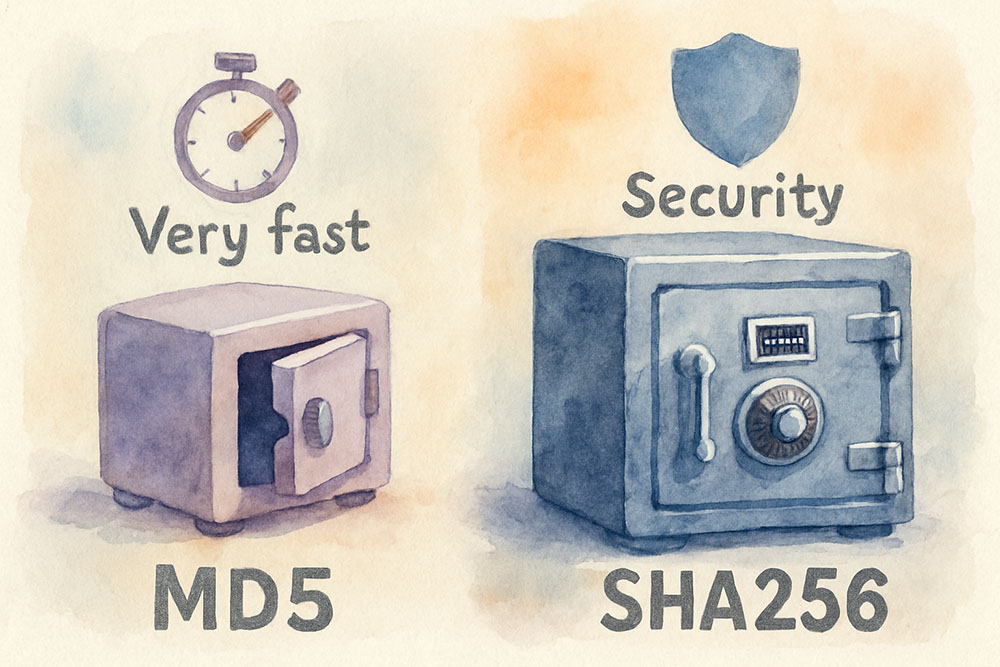
The two most famous algorithms are MD5 and SHA256. But they are not created equal. One is a fast workhorse; the other is a secure fortress.
MD5: The Fast, Broken Relic
MD5 (Message Digest 5) was designed in 1991. It produces a short, 32-character hexadecimal string.
Example: `5d41402abc4b2a76b9719d911017c592` (That is the hash for the word "hello").
The Good: It is incredibly fast. Generating an MD5 hash takes almost no computing power. It is short and easy to display.
The Bad: It is broken. Cryptographically broken. Researchers have found ways to generate "collisions" two different files that produce the exact same MD5 hash.
This means a hacker could create a malicious virus file that has the same MD5 fingerprint as a safe Windows update file. The computer would check the hash, think it is safe, and run the virus.
When to use MD5:
- Verifying file integrity for accidental corruption (e.g., did this file download correctly?).
- Checkingsumming non-critical data in a database.
- NEVER use it for passwords.
- NEVER use it for security certificates.
SHA256: The Industry Standard
SHA256 (Secure Hash Algorithm 256-bit) is the modern gold standard. It was designed by the NSA. It produces a longer, 64-character string.
The Good: It is secure. As of today, no one has ever found a collision for SHA256. It is statistically impossible to fake. This is why Bitcoin uses SHA256. This is why SSL certificates (the green lock in your browser) use SHA256.
The Bad: It is slower to calculate than MD5 (though on modern computers, the difference is negligible for small files). The string is longer, taking up more space in a database.
When to use SHA256:
- Storing passwords (though you should technically use bcrypt or Argon2, SHA256 is the absolute minimum baseline).
- Digital signatures.
- Blockchain applications.
- Any security-critical verification.
The Visual Test
Input: "apple"
MD5: `1f3870be274f6c49b3e31a0c6728957f`
SHA256: `3a7bd3e2360a3d29eea436fcfb7e44c735d117c42d1c1835420b6b9942dd4f1b`
Input: "applE" (capital E)
MD5: `77626966838321683935275037500331`
SHA256: `698d51a19d8a121ce581499d7b701668305d6a297779b7639d67568c07e0564d`
Notice the "Avalanche Effect." Changing one tiny letter completely changes the hash. There is no similarity. You cannot look at the hash and guess the input. That is the point.
Conclusion
If you are building a system today, default to SHA256. Storage is cheap; security breaches are expensive. Treat MD5 like a floppy disk a nice piece of history that is useful for quick checks, but not something you trust with your life savings.