
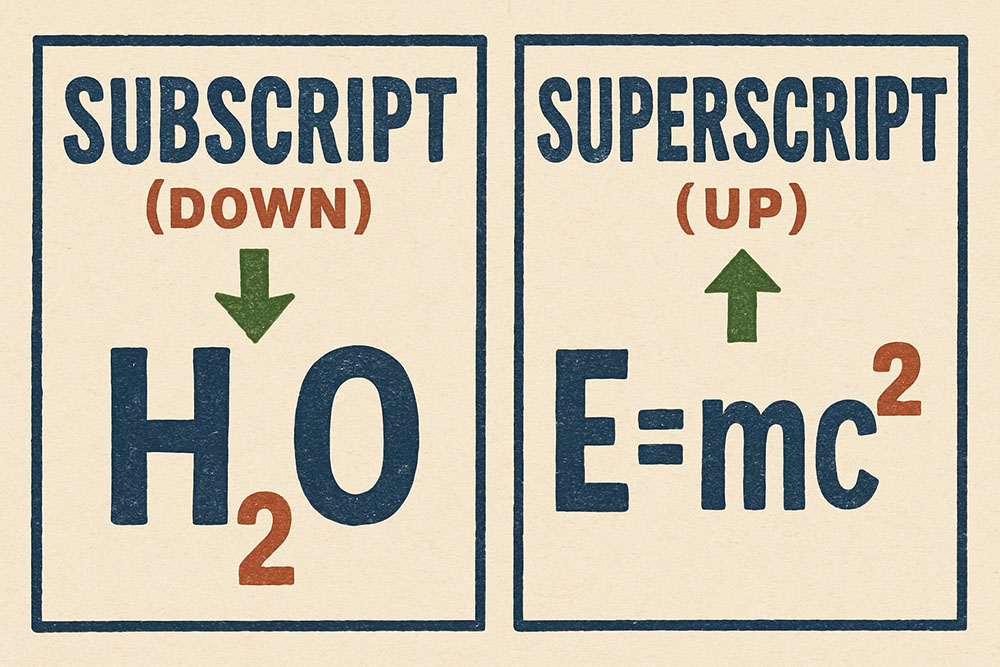
Up or Down: Why Direction Matters
It happens more often than you'd think. Someone tries to write a chemical formula in a hurry and ends up writing H2O with a normal "2". Or worse, they try to write "meters squared" and put the "2" down below. Visually, it's messy. Scientifically, it's incorrect.
Superscript and subscript are not interchangeable. They have distinct roles in scientific and mathematical notation. Knowing when to use which is basic literacy for anyone working with technical text, even if you are just formatting a blog post about water filters.
Subscript: The "Below" Text
Subscript characters sit slightly below the baseline. In the world of science, these are your identifiers. They tell you "how many" or "which one".
In chemistry, subscript indicates the number of atoms in a molecule. In H₂O, the subscript "₂" tells us there are two hydrogen atoms. If you wrote that as a superscript (H²O), a chemist might look at you funny because that notation doesn't exist in standard formulas. It changes the meaning entirely.
In mathematics, subscripts are used for sequences. If you have a list of variables, you label them x₁, x₂, x₃. It helps differentiate between different instances of the same variable type.
Superscript: The "Above" Text
Superscript floats above the midway line of the text. These are your power players. Literally.
The most common use is for exponents (powers). E = mc² is perhaps the most famous equation in history, and that little "2" has to be up top. It means "squared". If you drop it down, it just becomes a variable label.
We also use superscripts for ordinal indicators in dates (1ˢᵗ, 2ⁿᵈ, 3ʳᵈ), though this is more of a stylistic choice in modern writing. In academic papers, superscripts are the standard for footnote citations. You place a tiny number¹ at the end of a sentence to point to a reference.
The Unicode Solution
Here is the problem: standard keyboards don't have buttons for these. Word processors do, but social media doesn't. If you are tweeting about a physics discovery, you can't hit "Ctrl + Shift + +".
This is where Unicode generators come in handy. They swap your standard numbers for their specific Unicode equivalents (like ⁰¹² or ₀₁₂). It allows you to write accurate formulas in plain text environments like WhatsApp, Discord titles, or Instagram captions without needing a LaTeX editor.