
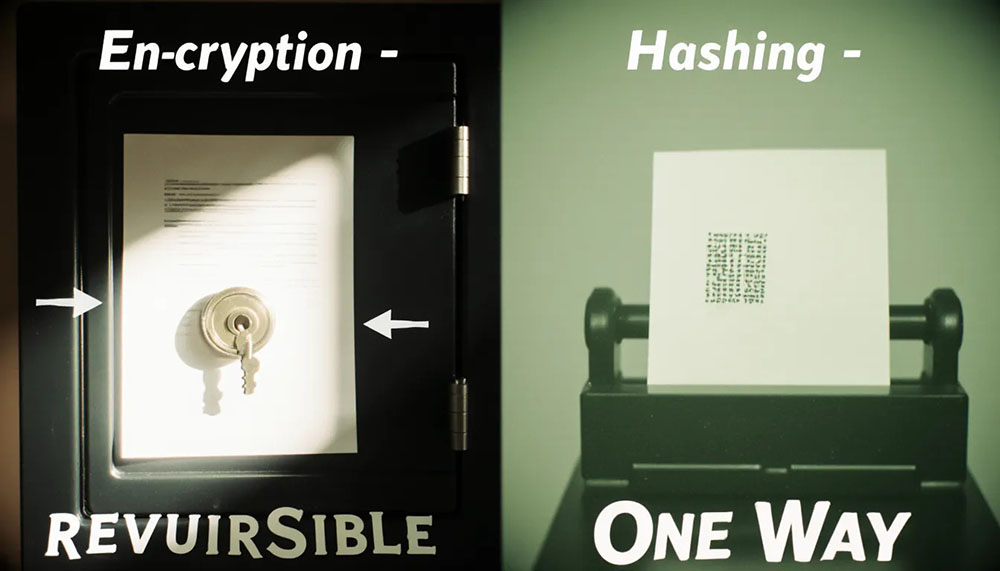
Two Tools, Two Jobs
In conversations about cybersecurity, people often use "encryption" and "hashing" interchangeably. They both involve scrambling data to protect it. They both use complex mathematics. They both sound intimidating. But treating them as the same thing is like confusing a safe with a seal. They serve fundamentally different purposes in the data protection ecosystem.
Encryption is designed to keep secrets. Hashing is designed to verify truth. Understanding this distinction is critical for anyone building secure systems, whether you are a developer storing user passwords or a business owner trying to secure customer data.
What is Encryption?
Encryption transforms readable data (plaintext) into scrambled nonsense (ciphertext) using a mathematical algorithm and a secret key [web:2]. The critical feature of encryption is that it is reversible. If you have the correct key, you can decrypt the ciphertext back into the original plaintext [web:3].
Think of encryption as a locked box. You put your valuable document inside, lock it with a key, and send the box to your friend. Only someone with the matching key can open the box and read the document. Without the key, the box is just a metal container full of noise.
Symmetric vs. Asymmetric Encryption
There are two main flavors of encryption [web:4]:
Symmetric Encryption uses the same key for both locking (encrypting) and unlocking (decrypting). AES (Advanced Encryption Standard) is the most common example. It is fast and efficient, which is why your WiFi router uses it. The downside? Both parties need to share the secret key securely. If the key is intercepted during transmission, the whole system collapses.
Asymmetric Encryption uses a pair of keys: a public key and a private key. You can freely share your public key with anyone. They use it to encrypt messages to you. Only your private key (which you never share) can decrypt those messages. RSA and ECC (Elliptic Curve Cryptography) are the heavy hitters here. This is what powers HTTPS, email encryption, and cryptocurrency wallets.
What is Hashing?
Hashing takes data of any size and runs it through a mathematical function to produce a fixed-length string of characters called a hash or digest [web:3]. The defining characteristic of hashing is that it is one-way. You cannot reverse a hash to get back the original data [web:2][web:4].
Think of hashing as a fingerprint. You can look at a fingerprint and confirm "Yes, this matches the person," but you cannot reconstruct a human body from a fingerprint. The fingerprint is unique, but it is not reversible.
Common Hash Functions
Popular hash algorithms include MD5, SHA-1 (both now considered insecure), SHA-256, and SHA-3. Modern systems default to SHA-256 because it produces a 256-bit hash that is computationally infeasible to reverse or fake [web:6].
A small change in the input causes a massive change in the output (the "Avalanche Effect" [web:7]). For example:
Input: "password"
SHA-256: `5e884898da28047151d0e56f8dc6292773603d0d6aabbdd62a11ef721d1542d8`
Input: "Password" (capital P)
SHA-256: `e7cf3ef4f17c3999a94f2c6f612e8a888e5b1026878e4e19398b23bd38ec221a`
The outputs are completely different. This property makes hashes excellent for detecting tampering.
Key Differences at a Glance
Purpose [web:2][web:3]:
- Encryption: Protects confidentiality. Keeps data secret during transmission or storage.
- Hashing: Ensures integrity. Verifies that data has not been altered.
Reversibility [web:4]:
- Encryption: Reversible with the correct key.
- Hashing: Irreversible. No key exists.
Output Length [web:3]:
- Encryption: Variable. Often similar to or larger than the input.
- Hashing: Fixed. SHA-256 always produces 64 hexadecimal characters, regardless of input size.
Real-World Use Cases
When to Use Encryption
Use encryption when you need to send data securely and the recipient needs to read it [web:8]:
- Sending credit card info to a payment processor (TLS/HTTPS encryption).
- Storing sensitive files on a hard drive (disk encryption like BitLocker).
- Messaging apps like Signal or WhatsApp (end-to-end encryption).
When to Use Hashing
Use hashing when you need to verify authenticity without storing the original [web:7]:
- Password storage. Never store passwords in plaintext. Store the hash.
- File integrity checks. Download a file and compare its hash to the published hash.
- Digital signatures. Sign a document by hashing it and encrypting the hash with your private key.
- Blockchain. Each block contains a hash of the previous block, creating an immutable chain.
The Fatal Mistake: Encrypting Passwords
A common misconception is that passwords should be encrypted. This sounds logical, but it is dangerously wrong. If you encrypt passwords, that means you can decrypt them. If you can decrypt them, so can an attacker who steals your encryption key. Game over.
Passwords should be hashed. When a user logs in, you hash their input and compare it to the stored hash. If they match, access granted. The system never needs to know the actual password [web:2].
Conclusion
Encryption and hashing are both pillars of modern security, but they are not interchangeable [web:4]. Encryption hides data so only authorized people can read it. Hashing creates a permanent, verifiable fingerprint to prove data has not been tampered with. Know which tool you need for the job, and your systems will be exponentially more secure.