
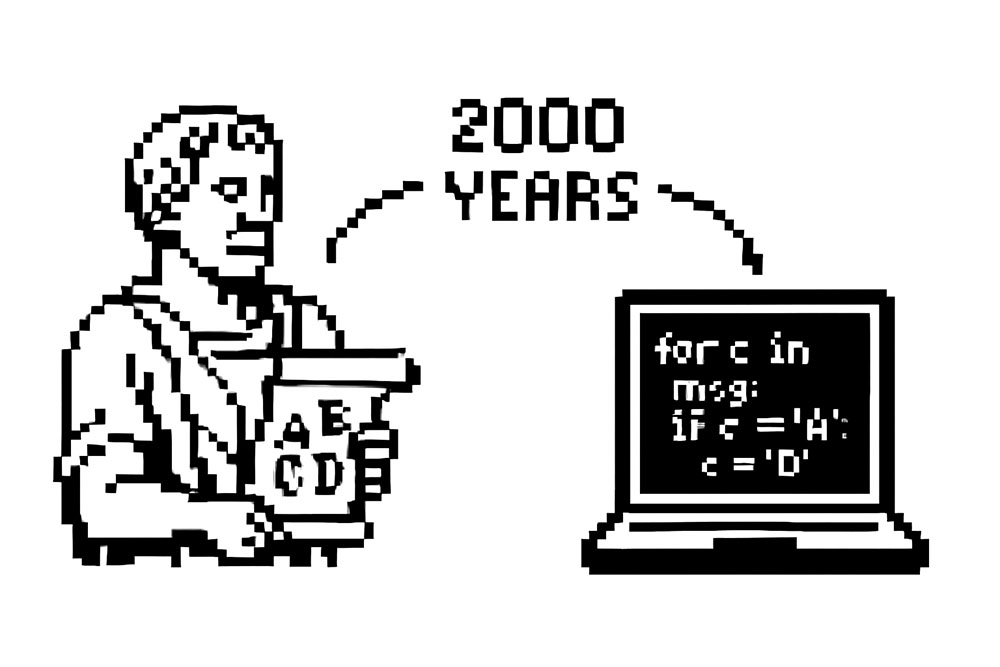
The 2000-Year-Old Algorithm
In 58 BC, Julius Caesar was waging war in Gaul (modern-day France). He needed to send military orders to his generals, but he faced a problem: if a messenger was captured by enemy forces, the message would fall into hostile hands. Caesar needed a way to obscure his commands.
His solution was brilliantly simple. He shifted every letter in his message by three positions in the alphabet. A became D, B became E, C became F, and so on. To anyone intercepting the message, it looked like gibberish. But his generals, who knew the "key" (shift by 3), could easily decode it.
This system became known as the Caesar Cipher, and it is the foundation of all substitution ciphers. While laughably insecure by modern standards, it represents the birth of cryptography as a military science.
How It Works: The Math Behind the Shift
The Caesar Cipher is a type of "shift cipher." Each letter is replaced by another letter a fixed number of positions down the alphabet.
If the shift is 3:
Plaintext: ATTACK AT DAWN
Ciphertext: DWWDFN DW GDZQ
The algorithm wraps around. If you shift "Z" by 3, it becomes "C" (wrapping around to the start of the alphabet).
The Formula
If we assign numbers to letters (A=0, B=1, C=2, ... Z=25), the encryption formula is:
E(x) = (x + k) mod 26
Where:
- x is the position of the plaintext letter.
- k is the shift key.
- mod 26 ensures the result wraps around the alphabet.
Decryption is just the reverse:
D(x) = (x - k) mod 26
Why It Was Effective in Ancient Rome
In Caesar's time, literacy rates were low. Most soldiers and common people could not read at all, let alone decode a shifted message. Even if an enemy captured a message, they would likely have no idea what to do with it. There were no computers. Breaking the cipher required manual trial and error, testing all 25 possible shifts.
For tactical battlefield communications where time was critical, this delay was enough. By the time the enemy decoded "ATTACK AT DAWN," dawn had already passed.
Breaking the Cipher: Frequency Analysis
The Caesar Cipher remained reasonably secure for centuries-until the advent of frequency analysis by Arab mathematicians around the 9th century.
In English, the letter "E" is the most common, followed by "T" and "A." If you have a large sample of ciphertext, you can count letter frequencies. The most common letter in the ciphertext is likely "E" shifted. If the most common letter is "H," the shift is probably 3 (E + 3 = H).
With this technique, any Caesar Cipher can be cracked in minutes without a computer.
Implementing the Caesar Cipher in Python
Today, the Caesar Cipher is a teaching tool. It is one of the first programs students write when learning cryptography or string manipulation. Here is a simple Python implementation:
def caesar_encrypt(text, shift):

    result = ""

    for char in text:

        if char.isalpha():

            start = ord('A') if char.isupper() else ord('a')

            result += chr((ord(char) - start + shift) % 26 + start)

        else:

            result += char

    return result
Modern Uses
While the Caesar Cipher is not secure, it still appears in modern contexts:
- ROT13: A Caesar Cipher with a shift of 13. Used in online forums to hide spoilers or mildly obscure text.
- CTF Competitions: Capture the Flag cybersecurity challenges often include Caesar Ciphers as beginner puzzles.
- Educational Tools: Teaching kids about cryptography and modular arithmetic.
Conclusion
The Caesar Cipher is a relic, but it is an important one. It shows us that cryptography is not just about complexity; it is about information asymmetry. Caesar had knowledge his enemies did not. Today, that knowledge has evolved into quantum-resistant algorithms, but the principle remains: control the key, control the message.