
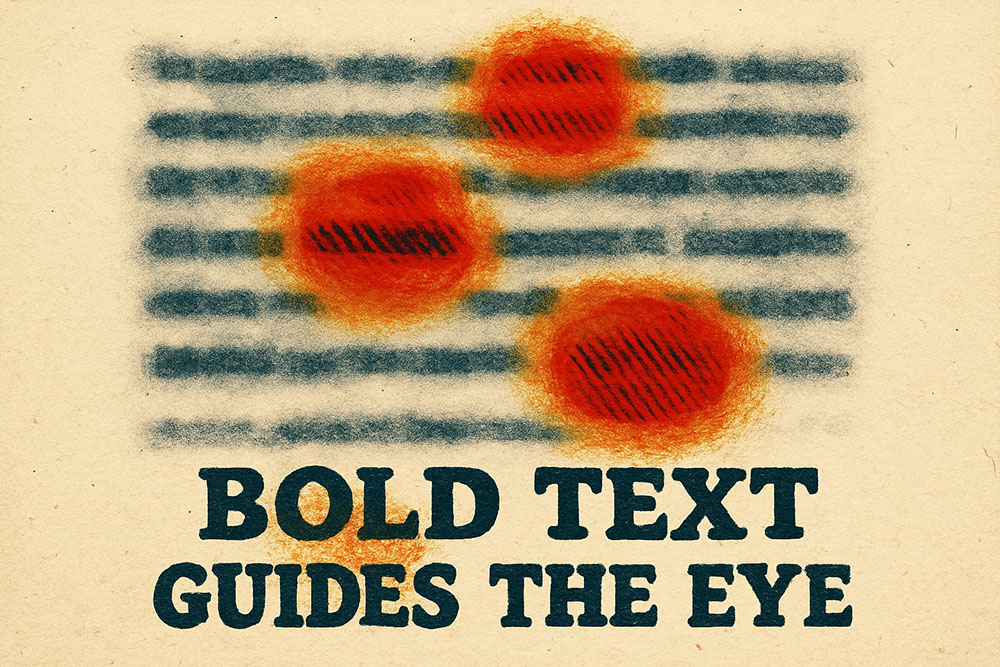
More Than Just Thicker Lines
When you bold a word, you aren't just making it thicker. You are changing how the reader's brain processes that information. It's a cue. A signal. It says, "If you read nothing else on this page, read this."
Bold text carries weight—literally and figuratively. In design psychology, heavier fonts are associated with strength, stability, and urgency. But like any strong spice, if you dump the whole bottle in, you ruin the dish.
The Anchor Effect
We scan content before we read it. In an F-shaped scanning pattern, our eyes look for anchors to latch onto. Bold text acts as that anchor.
If you have a wall of text with no variation, the reader's eye slides right off. It's slippery. When you bold key phrases, you create friction. You force the eye to stop. This is why skimming a well-formatted article is so easy—you can essentially get the summary just by reading the bold bits.
Perception of Authority
There is a reason why legal warnings and stop signs use thick, bold letters. It feels authoritative. It feels like a command rather than a suggestion.
If you are writing copy for a sales page, bolding the guarantee or the call to action makes it feel more solid. "We offer a 30-day money-back guarantee" feels more trustworthy than the same sentence in a thin, light font. Thin fonts can feel elegant, but they can also feel fragile or tentative.
The Danger of Overuse
Here is the trap. If everything is important, nothing is important. I see this all the time in emails or social captions where every other sentence is bolded.
When you overuse bold, it creates "visual noise." It's the typographic equivalent of someone shouting at you. The reader feels overwhelmed. Instead of guiding the eye, you are confusing it. The hierarchy is lost.
Use bold for:
- Headlines and subheads (obviously).
- Keywords that facilitate skimming.
- Crucial warnings or deadlines.
Don't use it for entire paragraphs unless you want your reader to feel exhausted.