
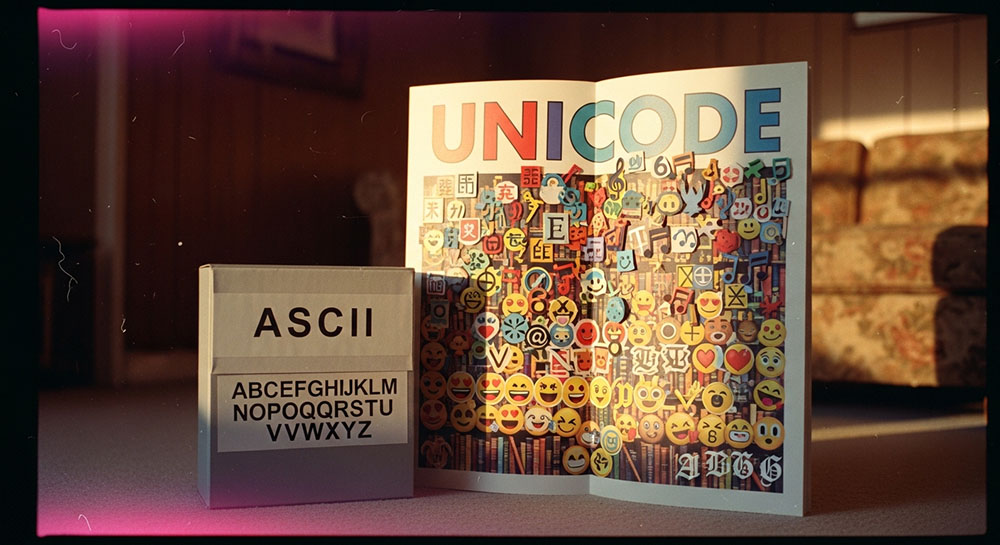
Why Your Keyboard Can't Type Everything
Have you ever wondered why you can type "A" and "B" directly, but you need a special tool to type "𝔄" or "𝔹"? It all comes down to the history of how computers talk to each other. It is the battle between the old world (ASCII) and the new world (Unicode).
The Old Box: ASCII
Back in the 1960s, computers were simple. They only needed to handle English text, numbers, and a few control codes (like "delete" or "new line"). They came up with ASCII (American Standard Code for Information Interchange). It was a list of 128 characters. That's it. Just 128 slots for everything.
If you wanted to type a letter with an accent, like "é", you were out of luck. If you wanted to type a math symbol, too bad. ASCII was a tiny box, and for a long time, we were all stuck inside it.
The Infinite Library: Unicode
Then came the internet. Suddenly, we needed to display Japanese, Arabic, Russian, and yes, Emojis. ASCII couldn't handle it. Enter Unicode.
Think of Unicode as a massive universal library where every character ever invented gets its own unique ID number. Currently, there are over 140,000 characters in Unicode. This includes the standard letters, but also hieroglyphs, music notes, and crucially for us mathematical alphanumeric symbols.
The "Font" Trick
Here is the secret behind text generators: they aren't actually generating "fonts." When you copy a "bold" text from our tool, you aren't copying the letter "A" with a bold style applied to it. You are copying a completely different character from the Unicode library called "Mathematical Bold Capital A."
To a computer, "A" (ASCII 65) and "𝐀" (Unicode U+1D400) are as different as "A" and "%". They just happen to look similar to our eyes. This is why you can paste them into Instagram or Twitter you aren't pasting formatting; you are pasting distinct symbols that exist in the universal library.